Atanuji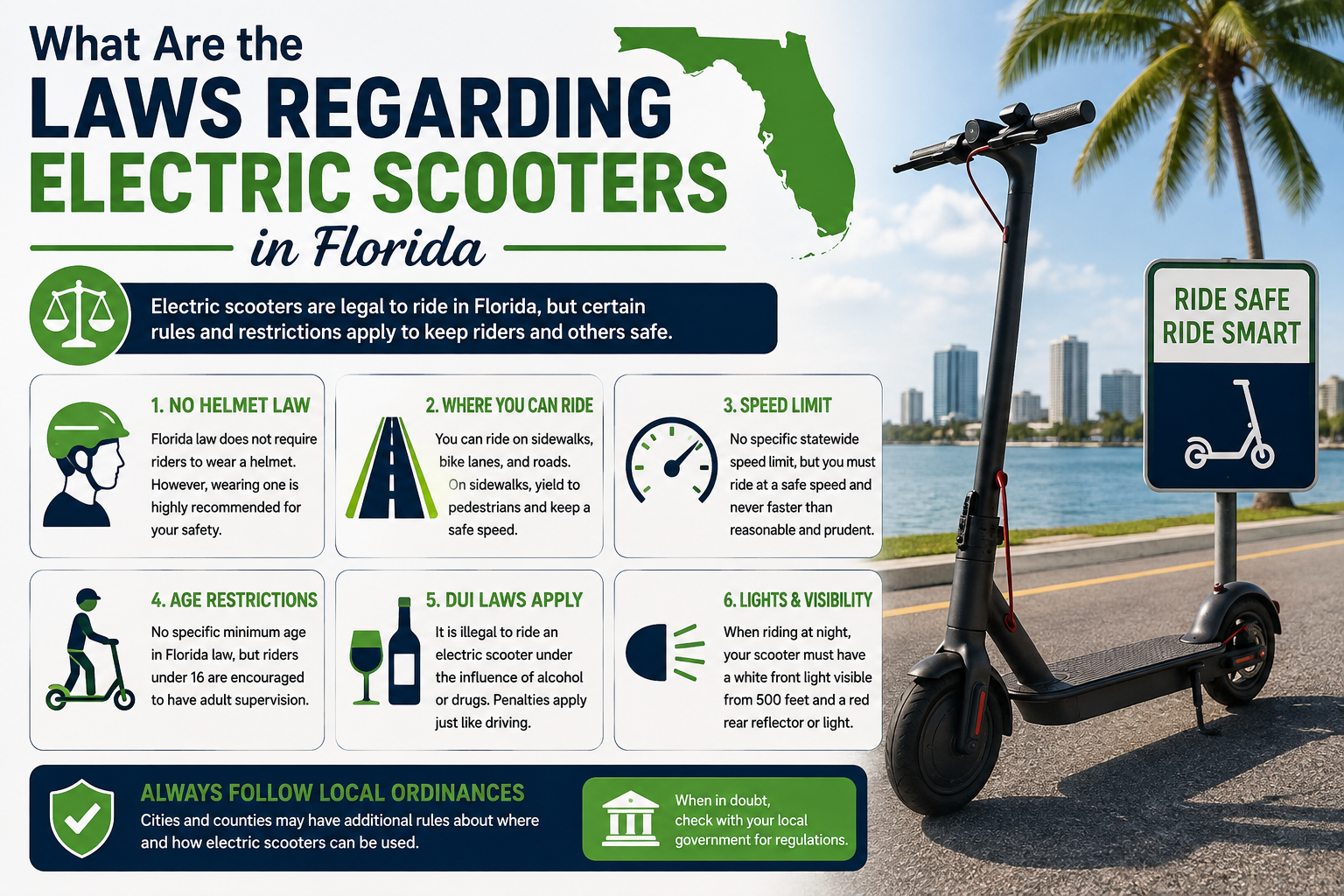
What Are the Laws Regarding Electric Scooters in Florida
Electric scooters have become an increasingly popular form of transportation in Florida. From daily commuting and short trips to sightseeing and traveling around busy downtown areas, these small electric vehicles offer a convenient alternative to cars. However, before riding an electric scooter on a Florida street or sidewalk, it is important to understand the laws that apply.
Florida has statewide laws governing motorized scooters and micromobility devices, but cities and counties can also create their own local regulations. As a result, the rules may vary depending on where you are riding.
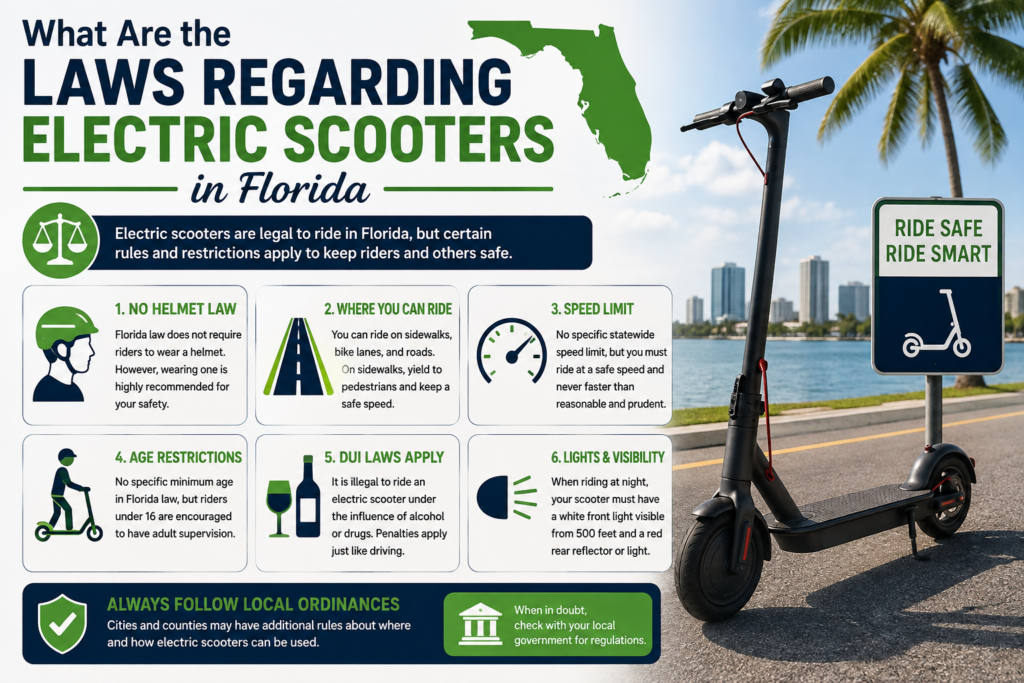
A rider may legally operate an electric scooter in one area but face restrictions in another. Questions about driver’s licenses, registration, insurance, age limits, sidewalks, roads, helmets, and traffic laws can all arise.
This article explains the major laws regarding electric scooters in Florida and provides a practical overview for riders.
Disclaimer: This article is for general informational purposes only and is not legal advice. Laws and local ordinances may change, so riders should check current state and local regulations before operating an electric scooter.
How Does Florida Law Define an Electric Scooter?
The first step in understanding Florida’s electric scooter laws is understanding how the state legally classifies these vehicles.
Under Florida law, a motorized scooter is generally a vehicle or micromobility device powered by a motor, with or without a seat or saddle, designed to travel on no more than three wheels, and not capable of traveling at more than 20 miles per hour on level ground. Electric bicycles are specifically excluded from this definition. (Florida Senate)
Florida law also recognizes the broader term micromobility device. The current statutory definition generally covers an individual-use motorized transportation device within specified physical and speed characteristics and can include devices such as bicycles, electric bicycles, and motorized scooters. (Florida Senate)
This distinction is important because not every electric-powered two-wheeled vehicle is legally treated as an ordinary electric scooter.What Are the Laws Regarding Electric Scooters in Florida
For example, an electric vehicle may potentially fall into a different category if it is:
- Capable of substantially higher speeds
- Designed differently from a typical scooter
- Classified as a motorcycle or moped
- Equipped with features that place it under different transportation laws
The legal classification of the vehicle can affect whether registration, licensing, insurance, or other requirements apply.
Florida’s Main Law on Electric Scooters
The primary statewide law dealing with motorized scooters and micromobility devices is Florida Statute Section 316.2128.
This statute provides the basic legal framework for operating qualifying electric scooters in Florida.
One of its most important provisions states that an operator of a motorized scooter or micromobility device generally has the same rights and duties that apply to a bicycle rider, subject to certain exceptions that do not apply because of the nature of the device. (Florida Senate)
This means that electric scooter riders should not think of themselves simply as pedestrians.
When operating in traffic, riders may need to follow applicable traffic rules similar to those followed by cyclists.
These can include obeying:
- Traffic lights
- Stop signs
- Yield signs
- Traffic-control devices
- Right-of-way rules
- Applicable roadway regulations
The law is designed to integrate scooters into Florida’s transportation system while allowing local governments to establish additional rules.
Do You Need a Driver’s License to Ride an Electric Scooter in Florida?
For qualifying motorized scooters and micromobility devices, Florida law states that a person is not required to have a driver’s license to operate the device. (Florida Senate)
This is one of the biggest differences between a typical qualifying electric scooter and many other motor vehicles.
A rider generally does not need to obtain a traditional automobile driver’s license simply to operate a qualifying scooter covered by the statute.
However, riders should be careful not to assume that every electric-powered vehicle qualifies.
A vehicle marketed as an “electric scooter” may have characteristics that place it into another legal category.
For example, a powerful electric vehicle capable of speeds beyond those associated with Florida’s definition of a motorized scooter may be regulated differently.
Before purchasing or riding a high-speed electric vehicle, the owner should determine its actual legal classification.
Do Electric Scooters Need to Be Registered?
Florida law provides that qualifying motorized scooters and micromobility devices are not required to satisfy the registration requirements referenced in the applicable motor vehicle registration statute. (Florida Senate)
Therefore, a typical qualifying electric scooter generally does not require:
- A license plate
- Standard motor vehicle registration
- Registration procedures similar to those required for cars
This makes electric scooters relatively simple to own and operate compared with motorcycles and automobiles.
However, once again, classification is important.
A high-powered electric vehicle may not automatically receive the same treatment simply because a manufacturer calls it a scooter.
The speed, design, motor capabilities, and other characteristics of the device can affect how it is regulated.
Is Insurance Required for Electric Scooters in Florida?
Qualifying motorized scooters and micromobility devices generally are not required to satisfy the motor vehicle insurance requirements referenced in Florida Statute Section 316.2128. (Florida Senate)
This means that an ordinary qualifying electric scooter rider is generally not required to maintain the same type of motor vehicle insurance required for many registered vehicles.
However, riders should understand that not being legally required to carry insurance does not eliminate financial responsibility.
An electric scooter accident can result in:
- Medical expenses
- Property damage
- Damage to another person’s vehicle
- Injuries to pedestrians
- Personal injury claims
- Potential legal disputes
If a rider causes an accident, the rider may potentially face financial liability.
Insurance coverage can depend on the circumstances and the policies involved. In some situations, homeowners, renters, personal liability, or specialized insurance coverage may be relevant.
Riders should review their own insurance policies rather than assuming that every scooter-related accident will automatically be covered.
Do Electric Scooter Riders Have to Follow Traffic Laws?
Yes. Florida law generally gives motorized scooter and micromobility device operators the rights and duties applicable to bicycle riders. (Florida Senate)
This means riders should obey applicable traffic rules while operating their scooters.
For example, a responsible rider should generally:
- Stop when legally required
- Obey traffic signals
- Yield when required
- Follow traffic-control signs
- Respect the right of way
- Travel predictably
- Avoid dangerous or reckless movements
An electric scooter should not be treated as a toy when it is being operated in or near traffic.
Even a relatively small scooter can create serious dangers when it enters an intersection unexpectedly or travels against the flow of traffic.
Traffic violations can also become important after an accident.
If a rider ignores a stop sign or red light and causes a collision, that conduct could potentially affect questions of liability.
Where Can You Ride an Electric Scooter in Florida?
This is one of the most important questions—and the answer may depend on the specific location.
Florida law allows local governments to adopt ordinances regulating the operation of micromobility devices and motorized scooters on streets, highways, sidewalks, and sidewalk areas under their jurisdiction. (Florida Senate)
As a result, riders should always consider both:
- Florida statewide law, and
- Local city or county regulations
A local government may establish rules concerning:
- Streets where scooters may operate
- Sidewalk riding
- Downtown areas
- Pedestrian zones
- Bicycle lanes
- Scooter parking
- Shared scooter programs
- Minimum rider ages
- Identification requirements
Because local governments have this authority, a rider should not assume that the rules are identical throughout Florida.
Can You Ride an Electric Scooter on Florida Roads?
Qualifying scooters may be operated subject to the applicable traffic laws and local regulations.
Since Florida law generally provides scooter riders with rights and duties similar to bicycle riders, roadway rules can be relevant when operating near traffic. (Florida Senate)
However, riders should carefully consider safety.
Electric scooters are relatively small and may be difficult for drivers to see.
They also travel much slower than many cars and trucks.
A scooter capable of traveling at 15 or 20 miles per hour can face significant danger on a road where surrounding traffic is moving at much higher speeds.
Riders should remain alert for:
- Vehicles turning across their path
- Opening car doors
- Vehicles entering from driveways
- Poor road surfaces
- Potholes
- Loose gravel
- Wet pavement
Local restrictions may also affect where a scooter can legally operate.
Before riding on a particular road, it is wise to check for signs or local rules that may limit scooter access.
Can You Ride an Electric Scooter on the Sidewalk?
Sidewalk rules can vary significantly because Florida law permits local governments to regulate scooters and micromobility devices on sidewalks and sidewalk areas under their jurisdiction. (Florida Senate)
Therefore, a rider should never assume that riding on every Florida sidewalk is automatically permitted.
Some communities may allow sidewalk operation in certain circumstances.
Others may restrict scooters in busy commercial areas or locations with large numbers of pedestrians.
Restrictions may be especially common in:
- Downtown districts
- Tourist destinations
- Shopping areas
- Entertainment zones
- Crowded pedestrian locations
Even when sidewalk riding is allowed, riders should prioritize pedestrian safety.
Pedestrians have limited protection against a collision with an electric scooter.
A rider should slow down, provide space, and avoid aggressive maneuvering around people walking.
Can Local Governments Set Age Requirements?
Yes. Under the current Florida statute, a local government may adopt an ordinance establishing one or more minimum age requirements for operating a motorized scooter or micromobility device. (Florida Senate)
This is another reason local laws are important.What Are the Laws Regarding Electric Scooters in Florida
A statewide rule may not establish the exact same minimum age requirement that a particular city or local government chooses to adopt.
Local governments may also adopt an ordinance requiring an operator to possess a government-issued photographic identification while operating a scooter or micromobility device. (Florida Senate)
In addition, rental companies may establish their own age requirements and account rules.
Therefore, riders should consider:
- State law
- Local ordinances
- Rental company policies
Parents should also carefully consider whether a child has the experience and maturity necessary to operate an electric scooter safely.
Are Helmets Required?
Helmet laws can depend on the legal classification of the device and the circumstances involved.
Because different Florida laws apply to bicycles, motorcycles, and other types of vehicles, riders should not assume that the helmet requirements for one category automatically apply to another.
Even where a helmet is not legally required, wearing one is strongly recommended.
Electric scooter riders have very little physical protection.
A fall can result in:
- Head injuries
- Facial injuries
- Broken bones
- Cuts and abrasions
- Spinal injuries
A serious accident can occur even at relatively low speeds.
A properly fitted helmet can significantly improve rider protection.
Other useful protective equipment may include:
- Gloves
- Knee pads
- Elbow pads
- Protective clothing
Electric Scooter Safety Equipment
Florida’s traffic and equipment laws can be complex, especially when different types of devices are involved.
Regardless of the minimum legal requirements, electric scooter riders should make sure their scooters are properly maintained.
Before riding, check:
- Brakes
- Tires
- Wheels
- Steering
- Battery condition
- Lights
- Reflective equipment
Nighttime riding deserves additional attention.
A small scooter can be difficult for motorists to see after dark.
Riders should consider using:
- A bright front light
- A visible rear light
- Reflective materials
- Bright clothing
Being visible is one of the most important ways to reduce accident risks.
Do You Need to Obey Speed Limits?
Electric scooter riders should operate safely and comply with applicable traffic laws and local restrictions.
A typical Florida motorized scooter is defined in part by its inability to exceed 20 miles per hour on level ground. (Florida Senate)
However, operating below a scooter’s maximum capability does not automatically make every speed safe.
A rider should reduce speed in areas such as:
- Sidewalks
- Crosswalks
- Intersections
- Parking lots
- Areas with pedestrians
- Wet or slippery roads
The safest speed depends on the surrounding environment.
A speed that may be reasonable on an open pathway could be extremely dangerous in a crowded pedestrian area.
Electric Scooters and Bicycle Laws
Florida’s law makes bicycle rules especially relevant to electric scooter riders.
Section 316.2128 generally provides scooter and micromobility device operators with the rights and duties applicable to bicycle riders, although some specific bicycle requirements are excluded because they do not naturally apply to scooters. (Florida Senate)
This legal approach helps establish that scooter riders are expected to participate responsibly in Florida’s transportation system.
Riders should therefore familiarize themselves with applicable bicycle-related traffic rules, particularly when operating on or near public roads.
A scooter rider should not assume that being on a smaller vehicle provides an exemption from traffic laws.
Parking Rules for Electric Scooters
Parking is another important issue, particularly with shared rental scooters.
Improperly parked scooters can create hazards for:
- Pedestrians
- Wheelchair users
- People with mobility impairments
- Parents using strollers
- Other scooter and bicycle riders
A scooter should never be left in a location where it blocks:
- Building entrances
- Driveways
- Sidewalk access
- Wheelchair routes
- Public transportation areas
Local governments and scooter companies may establish specific parking requirements.
Some shared scooter programs may require riders to park:
- In designated zones
- In approved areas
- Outside restricted locations
Responsible parking is an important part of safe scooter use.
Rules for Rental and Shared Electric Scooters
Shared electric scooter services have created additional regulatory concerns.
Florida’s statute includes a requirement for persons offering motorized scooters or micromobility devices for hire to secure devices located in an area where an active tropical storm or hurricane warning has been issued by the National Weather Service. (Florida Senate)
This requirement reflects Florida’s unique weather risks.
During severe storms, unsecured scooters can become hazards.
Rental companies may also establish their own rules regarding:
- Rider age
- Account eligibility
- Payment
- Proper parking
- Riding locations
- One rider per scooter
- Helmet recommendations
Breaking a company’s terms of service may result in penalties or account suspension even if the conduct does not result in a criminal charge.
Can You Carry a Passenger?
Most stand-up electric scooters are designed for a single rider.
Carrying an additional passenger can be dangerous because it may:
- Reduce balance
- Make steering more difficult
- Increase stopping distance
- Exceed the manufacturer’s weight limit
- Increase the risk of a crash
A rider should follow the manufacturer’s instructions and avoid using a scooter in a manner for which it was not designed.
Two people riding on a single-person scooter can significantly increase the risk of injury.
What Happens If You Break Scooter Laws?
Violating traffic laws or local scooter regulations can result in consequences depending on the specific situation.
Possible consequences may include:
- Traffic citations
- Fines
- Local ordinance violations
- Civil liability
- Responsibility for property damage
A serious accident may create additional legal issues.
For example, a scooter rider who ignores a traffic signal and collides with a vehicle may face questions about responsibility for the accident.
Similarly, a rider operating in an area where scooters are prohibited may face penalties under applicable local rules.
The specific consequences depend on the facts and the laws that apply in that location.
Liability After an Electric Scooter Accident
Electric scooter accidents can involve complicated legal questions.
Potentially responsible parties may include:
- The scooter rider
- A car or truck driver
- Another scooter rider
- A cyclist
- A pedestrian
- A scooter rental company
- A product manufacturer in certain situations
For example, if a motor vehicle driver fails to yield and strikes a scooter rider, the driver’s conduct may be important.
If a rider was speeding, ignoring traffic signals, or operating carelessly, the rider’s conduct may also be examined.
Evidence that may become important includes:
- Police reports
- Photographs
- Videos
- Witness statements
- Traffic camera footage
- Vehicle damage
- Medical records
- Information about the scooter
Because every accident is different, liability depends heavily on the specific facts.
What Should You Do After an Electric Scooter Accident?
If an accident occurs, safety should be the first priority.
Check for injuries
Call emergency services when someone is seriously injured.
Head injuries should always be taken seriously.
Move out of danger
If it is safe to do so, move away from active traffic.
Do not create additional risks by remaining in the path of vehicles.
Document the scene
Take photographs of:
- The scooter
- Vehicles involved
- Road conditions
- Traffic signals
- Signs
- Visible injuries
Collect information
Obtain relevant contact and insurance information when a motor vehicle is involved.
Preserve evidence
Do not immediately repair or dispose of the scooter if its condition could be relevant to determining what caused the accident.
Seek appropriate assistance
Medical or legal assistance may be appropriate depending on the seriousness of the situation.
Electric Scooters Are Different From Electric Bicycles
Florida law specifically distinguishes electric bicycles from motorized scooters. The statutory definition of a motorized scooter does not include an electric bicycle. (Florida Senate)
This distinction matters because electric bicycles can be regulated under different legal provisions.
Before determining which laws apply, consider:
- Does the vehicle have pedals?
- How fast can it travel?
- Does it have a seat?
- How is it powered?
- How is it classified under Florida law?
A device’s marketing name does not necessarily determine its legal classification.
Electric Scooters Versus Motorcycles and Mopeds
A more powerful electric two-wheeled vehicle may fall under a different legal category.
Motorcycles and other vehicles may have requirements involving:
- Driver licensing
- Registration
- License plates
- Insurance
- Safety equipment
Florida’s definition of a motorcycle is different from its definition of a motorized scooter. (Florida Senate)
For this reason, people purchasing a high-speed electric vehicle should carefully research the applicable laws before riding on public roads.
A vehicle called an “electric scooter” by a manufacturer may not automatically qualify as a Florida motorized scooter.
Important Safety Tips for Florida Electric Scooter Riders
Following the law is essential, but safe riding requires additional common sense.
Wear a helmet
Even if you believe one is not legally required, a helmet can provide important protection.
Inspect your scooter
Check the brakes, tires, battery, and lights before riding.
Stay visible
Use lights and reflective materials when riding in low-light conditions.
Avoid distractions
Do not allow a phone or other distraction to reduce your awareness of traffic.
Watch the road surface
Small scooter wheels can be vulnerable to potholes, cracks, railroad tracks, and loose gravel.
Slow down near pedestrians
Crowded areas require additional caution.
Follow local regulations
Always check city and county rules before riding in a new area.
Quick Summary of Florida Electric Scooter Laws
Here are some of the most important points to remember:
Definition: A Florida motorized scooter generally has a motor, travels on no more than three wheels, and is not capable of exceeding 20 miles per hour on level ground. (Florida Senate)
Driver’s license: A person generally does not need a driver’s license to operate a qualifying motorized scooter or micromobility device. (Florida Senate)
Registration: Qualifying devices generally do not have to meet the referenced motor vehicle registration requirements. (Florida Senate)
Insurance: Qualifying devices generally do not have to satisfy the referenced motor vehicle insurance requirements. (Florida Senate)
Traffic laws: Operators generally have rights and duties similar to those applicable to bicycle riders. (Florida Senate)
Local laws: Cities and other local governments can regulate scooters on streets, highways, sidewalks, and sidewalk areas under their jurisdiction. (Florida Senate)
Age requirements: Local governments may adopt minimum age requirements. (Florida Senate)
Identification: Local governments may adopt rules requiring government-issued photographic identification while operating a scooter. (Florida Senate)
Conclusion
Electric scooters provide a convenient and increasingly popular way to travel around Florida. However, convenience does not mean riders are free from legal responsibilities.
Florida law provides a statewide framework for motorized scooters and micromobility devices. Qualifying devices generally do not require traditional motor vehicle registration, insurance, or a driver’s license, and their operators generally have many of the same rights and duties as bicycle riders. (Florida Senate)
At the same time, local governments have significant authority to regulate where and how electric scooters can be operated.
This makes it essential for riders to check local ordinances before riding on streets, sidewalks, or other public areas.
The most important rule for any rider is to understand the legal classification of their device. Not every electric-powered vehicle is legally considered a motorized scooter.
Riders should also obey traffic laws, respect pedestrians, operate at safe speeds, maintain their scooters properly, and use protective equipment whenever possible.
By understanding both Florida’s statewide laws and local regulations, electric scooter riders can enjoy the benefits of this form of transportation while reducing the risk of legal problems and accidents.
For the most current official information, consult the 2026 Florida Statute §316.2128 and the relevant definitions in Florida Statute §316.003.