Atanuji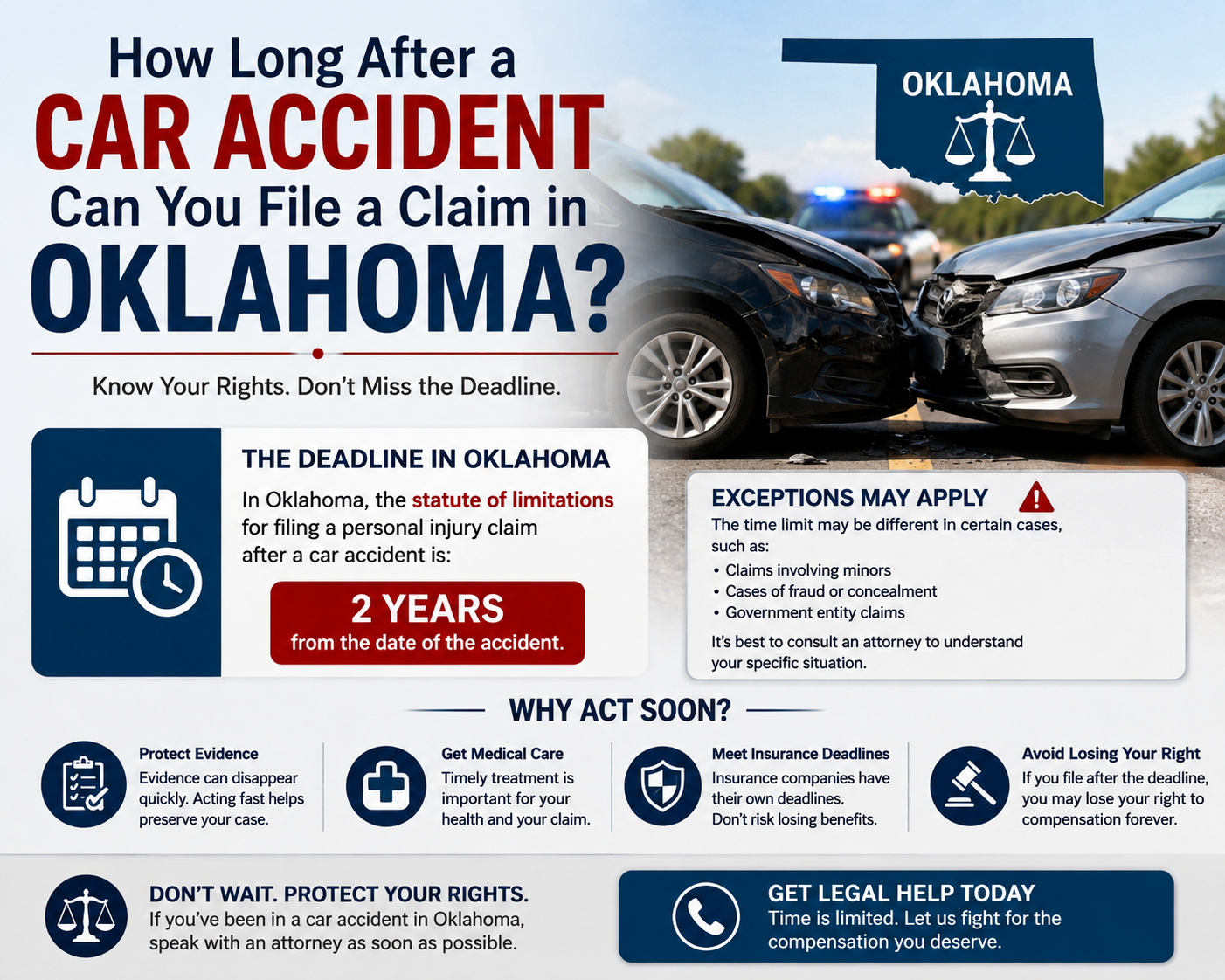
How Long After a Car Accident Can You File a Claim in Oklahoma
A car accident can turn an ordinary day into a stressful and confusing experience. After a crash, people often focus first on medical treatment, vehicle repairs, insurance paperwork, and getting back to work. Legal deadlines may be the last thing on their minds. However, waiting too long to pursue compensation can put an otherwise valid claim at risk.
If you were injured or your vehicle was damaged in a car accident in Oklahoma, one of the most important questions is: How long do you have to file a claim?
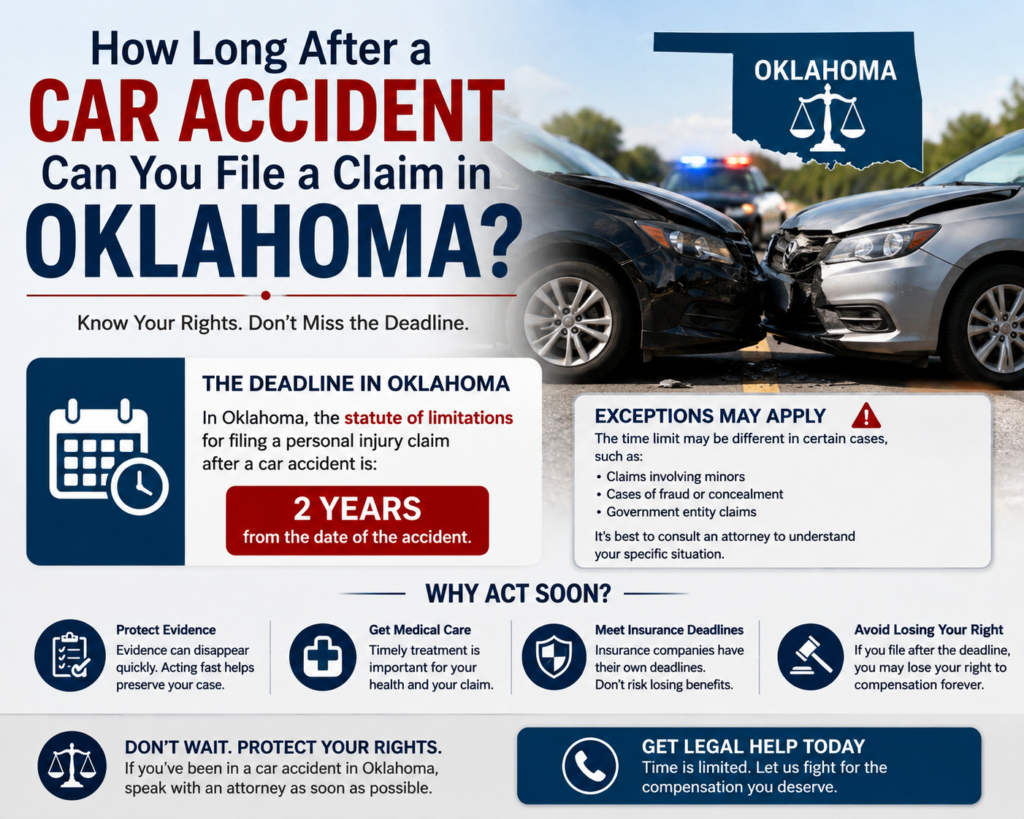
In general, Oklahoma provides a two-year statute of limitations for many car-accident personal injury and property-damage lawsuits. Oklahoma’s statute, 12 O.S. § 95(A)(3), establishes a two-year period for certain actions involving injury to another’s rights and injury to personal property. Oklahoma courts have also recognized a two-year limitations period for negligence claims. (Justia Law)
But there is an important distinction between filing an insurance claim and filing a lawsuit. Your insurance policy may contain its own requirements for reporting an accident, and delaying an insurance claim can create unnecessary problems even if the two-year lawsuit deadline has not expired.
This guide explains Oklahoma’s deadlines, what can happen if you wait, how insurance claims work, possible exceptions, and practical steps you can take after a collision.
Important: This article is general legal information, not legal advice. The deadline in an individual case can depend on the facts, the parties involved, the type of claim, and applicable Oklahoma law. If you have been seriously injured, consult a qualified Oklahoma attorney promptly.
1. The Short Answer: Usually Two Years
For many ordinary car accident injury claims in Oklahoma, the applicable statute of limitations is two years.
Oklahoma’s Title 12, Section 95 provides that certain civil actions must be brought within two years after the cause of action accrues. The statute includes actions for injury to personal property and actions for injury to another’s rights that do not arise from a contract. (Justia Law)
Oklahoma courts have specifically stated that a two-year statute of limitations applies to negligence claims. Since many motor-vehicle accident lawsuits are based on negligence—for example, careless driving, distracted driving, speeding, or following too closely—the two-year period is often the central deadline in a car accident case. (FindLaw)
Example
Suppose you were involved in a collision on September 2, 2026.
If the ordinary two-year statute applies, you generally would need to commence your lawsuit by approximately September 2, 2028.
That does not mean you should wait until 2028 to contact an insurance company or attorney.
In fact, waiting can make your case considerably more difficult.
2. An Insurance Claim Is Not the Same as a Lawsuit
This distinction is extremely important.
When people say they want to “file a car accident claim,” they may mean one of two different things:
- An insurance claim, or
- A lawsuit in court.
They are related but not identical.
An insurance claim is typically a request for compensation from an insurance company. Depending on the circumstances, you might file a claim with:
- The other driver’s liability insurer
- Your own insurance company
- Your collision coverage
- Your uninsured motorist coverage
- Your underinsured motorist coverage
A lawsuit, on the other hand, is a formal legal action filed in court against the person or entity you believe is responsible.
The Oklahoma Insurance Department advises motorists to contact their insurance company as soon as possible after an accident. It also recommends exchanging insurance and contact information, photographing the scene when possible, obtaining witness information, and obtaining a police report where appropriate. (Oklahoma Insurance Dept.)
Therefore, the two-year statute of limitations should not be interpreted as permission to wait two years before notifying an insurer.
3. How Long Do You Have to File a Personal Injury Lawsuit?
For many Oklahoma car accident cases involving bodily injury, the relevant period is two years.
A personal injury lawsuit may seek compensation for losses such as:
- Emergency medical treatment
- Hospital bills
- Doctor visits
- Prescription expenses
- Physical therapy
- Lost wages
- Reduced earning capacity
- Pain and suffering
- Certain other economic and noneconomic damages
The exact damages available depend on the circumstances of the case and Oklahoma law.
The Oklahoma Supreme Court has recognized that negligence actions fall under the two-year limitations period in 12 O.S. § 95(A)(3). (FindLaw)
That means someone who believes another driver’s negligence caused an injury generally should not assume that they can bring a lawsuit whenever they choose.
4. What About Vehicle Damage?
Property damage can also be subject to a two-year limitations period under Oklahoma law.
Section 95(A)(3) specifically identifies actions involving the taking, detaining, or injuring of personal property and provides a two-year period for those actions. (Justia Law)
Your vehicle is personal property, so a dispute involving accident-related vehicle damage can raise the two-year limitations rule.
However, this does not mean you should wait two years before seeking repairs or submitting a property-damage claim.
In fact, vehicle damage should generally be addressed as soon as reasonably possible because:
- Repair estimates can change.
- Evidence can disappear.
- Storage charges can accumulate.
- A damaged vehicle may deteriorate.
- Photographs may become harder to obtain.
- Insurance companies may want to inspect the vehicle.
- Witnesses may become difficult to locate.
The Oklahoma Insurance Department recommends contacting your insurer promptly after an accident and explains that collision coverage generally addresses damage to your own vehicle from a collision, while liability coverage can apply to damage you cause to another person’s vehicle or property. (Oklahoma Insurance Dept.)
5. Why You Should Not Wait Until the Two-Year Deadline
Even when the law provides two years, waiting can be risky.
A car accident case often depends on evidence. As time passes, evidence can become harder to obtain.
For example:
Witnesses may forget what happened
A witness who clearly remembers the accident a week afterward may have difficulty remembering details a year later.
Surveillance footage may disappear
Businesses, traffic systems, parking lots, and homes may have cameras. But video recordings are often retained for only limited periods.
Vehicle evidence can be lost
If the vehicles are repaired, sold, destroyed, or otherwise altered, evidence concerning the crash may become more difficult to preserve.
Medical documentation can become complicated
If you delay medical treatment or have long gaps in treatment, an insurance company may argue that your injuries were unrelated to the accident or were less serious than claimed.
Memories change
Drivers and witnesses can remember events differently as time passes.
For these reasons, the legal deadline should be treated as a maximum deadline in many cases, not a recommended waiting period.
6. What If Your Injuries Appear Later?
Not every car accident injury is immediately obvious.
Some people experience significant symptoms immediately after a collision. Others may initially feel relatively normal and develop symptoms later.
Examples can include:
- Neck pain
- Back pain
- Headaches
- Soft-tissue injuries
- Joint problems
- Nerve symptoms
- Psychological effects
- Other accident-related conditions
Oklahoma recognizes a discovery rule in certain tort cases. Oklahoma courts have explained that, in appropriate circumstances, limitations may be tolled until the injured party knows, or through reasonable diligence should have known, of the injury. (FindLaw)
However, you should not automatically assume that discovering an injury months later means you receive a new two-year period beginning on the date you noticed the symptoms.
The rules surrounding accrual and discovery can be fact-specific.
If you developed symptoms after an accident, documenting when the symptoms began and seeking appropriate medical evaluation can be important.
7. What If the Other Driver Was Uninsured?
Oklahoma requires automobile liability insurance, but uninsured and underinsured drivers remain a real concern.
The Oklahoma Insurance Department explains that uninsured/underinsured motorist coverage, commonly called UM/UIM coverage, can protect an insured person when the driver who caused the accident does not have enough insurance. It can also apply in certain hit-and-run situations. (Oklahoma Insurance Dept.)
If the at-fault driver has no insurance, your own policy may become particularly important.
You should notify your insurer promptly and review your policy carefully.
Don’t assume that because you have a certain number of years to bring a lawsuit against another driver, you can ignore your insurance policy’s notice requirements.
UM/UIM claims can involve additional legal and contractual issues, including policy language, notice requirements, settlement procedures, and the insurer’s rights.
8. What If the Other Driver Has Very Little Insurance?
A driver may have insurance but still lack enough coverage to pay for serious injuries.
For example, imagine:
- Your medical expenses are $100,000.
- You lose substantial income.
- You have a significant long-term injury.
- The at-fault driver’s insurance coverage is insufficient.
In that situation, underinsured motorist coverage may become important if you have applicable UM/UIM protection.
The Oklahoma Insurance Department explains that UM/UIM coverage is intended to protect against losses when the responsible driver lacks sufficient insurance and notes that insurers must offer UM coverage when automobile insurance is purchased, subject to the consumer’s ability to decline it through the required process. (Oklahoma Insurance Dept.)
Because insurance policies differ, an attorney or insurance professional can help you understand how your particular policy applies.
9. What If the Accident Involved a Government Vehicle?
Extra caution is required when the accident involves a government entity or employee.
Claims against governmental bodies can be subject to special statutory procedures and deadlines that differ from an ordinary claim against a private driver.
For example, an accident could involve:
- A city vehicle
- A county vehicle
- A state vehicle
- A government employee
- A public transportation vehicle
- Certain other governmental entities
In such situations, you should not simply assume that the ordinary two-year deadline applies in exactly the same way.
Governmental claims can involve notice requirements and shorter deadlines.
If a government vehicle was involved in your accident, speaking with an Oklahoma attorney as soon as possible is particularly important.
10. What If the Injured Person Is a Minor?
Cases involving children can involve different rules concerning limitations periods.
Oklahoma law contains provisions addressing people under legal disability. Section 12-96 provides special rules concerning persons under disability in certain actions. (Oklahoma Senate)
Oklahoma case law has also discussed how disability provisions can interact with the two-year limitations period for personal injury claims. (Casemine)
Because the circumstances can vary substantially, parents or guardians should not assume that the standard adult deadline automatically applies.
If a child was injured in a collision, obtaining legal advice promptly can help prevent an important deadline from being overlooked.
11. What Happens If You Miss the Deadline?
The consequences can be serious.
If a lawsuit is filed after the applicable statute of limitations has expired, the opposing party may raise the statute of limitations as a defense.
In many circumstances, a court may dismiss a claim that was filed too late.
This can mean losing the ability to pursue compensation through the courts, even if:
- The other driver was clearly negligent.
- You suffered significant injuries.
- You have substantial medical bills.
- The other driver had insurance.
- You have strong evidence of fault.
That’s why identifying the correct deadline is one of the earliest steps an attorney may take when evaluating a potential accident case.
12. Does Talking to an Insurance Company Stop the Clock?
Generally, you should not assume that communicating with an insurance company stops the statute of limitations.
For example, suppose your accident happened in January 2026.
You might:
- Report the accident in January.
- Exchange documents with the insurer in February.
- Receive an offer in April.
- Negotiate throughout the summer.
- Continue negotiating into 2027.
Those negotiations do not automatically mean the court deadline disappears.
The distinction between an insurance negotiation and formally commencing a lawsuit is extremely important.
If negotiations are continuing as a deadline approaches, you should obtain legal advice rather than assuming the insurance company will protect your legal rights.
13. How Quickly Should You Notify Your Insurance Company?
As soon as reasonably possible.
The Oklahoma Insurance Department specifically advises motorists to contact their insurance company as soon as possible after an accident. (Oklahoma Insurance Dept.)
When reporting an accident, you may need information such as:
- Date and time of the accident
- Location
- Names of drivers
- Insurance information
- Vehicle information
- Police report information
- Photographs
- Witness information
- Description of damage
- Medical information, if applicable
Your policy may contain its own notice requirements.
Reading your policy and following its reporting procedures can help avoid unnecessary disputes.
14. Should You Get a Police Report?
A police report can be an important piece of evidence.
The Oklahoma Insurance Department recommends obtaining a police report following an auto accident and advises calling 911 if someone has a life-threatening injury or contacting police directly when there is no emergency. (Oklahoma Insurance Dept.)
A report may contain information about:
- Drivers
- Vehicles
- Location
- Statements
- Citations
- Witnesses
- Road conditions
- Officer observations
However, a police report is only one piece of evidence. It does not necessarily decide who is legally responsible for every aspect of a civil claim.
15. Evidence You Should Preserve After an Oklahoma Car Accident
If you are considering an insurance claim or lawsuit, preserving evidence can be extremely valuable.
Take photographs
Photograph:
- Your vehicle
- The other vehicle
- The accident scene
- Road conditions
- Traffic signs
- Skid marks
- Debris
- Visible injuries
Keep medical records
Maintain copies of:
- Medical bills
- Treatment records
- Prescription receipts
- Physical therapy records
- Diagnostic testing
- Doctor’s notes
Document lost income
If your injuries prevent you from working, retain relevant employment and wage records.
Save communications
Keep:
- Emails
- Letters
- Text messages
- Insurance communications
- Settlement offers
Identify witnesses
Write down witness names and contact information as soon as possible.
Preserve photographs and videos
Do not assume that a social-media post, dashcam recording, or surveillance video will remain available indefinitely.
16. What Should You Do If the Insurance Company Offers a Settlement?
Be careful before accepting a settlement.
An insurance settlement may resolve some or all of your claims. Depending on the agreement, accepting the money and signing a release could prevent you from later seeking additional compensation for the same accident.
This is particularly important when you are still receiving medical treatment.
For example, imagine you receive a settlement offer shortly after the crash but later discover that you need extensive treatment.
Before signing a release, understand:
- What claims are being released?
- How much money are you receiving?
- Are future medical expenses included?
- Are lost wages included?
- Are liens or medical bills involved?
- Does the settlement resolve property damage?
- Does it resolve bodily injury claims?
- Are there insurance coverage issues?
For serious injuries, professional legal review may be worthwhile before accepting a settlement.
17. Can You File a Claim Even If You Were Partly at Fault?
Possibly.
Oklahoma follows comparative negligence principles, meaning a person’s own share of responsibility can affect the amount of compensation available.
For example, if a jury determines that:
- The other driver was 80% responsible, and
- You were 20% responsible,
your recovery may be affected by your percentage of fault under the applicable Oklahoma rules.
Because comparative negligence can become complicated, particularly when multiple drivers are involved, you should avoid assuming that being partially responsible automatically eliminates your claim.
Likewise, don’t assume that an insurance company’s determination that you were partially at fault is necessarily the final legal answer.
18. Why Medical Treatment Matters After a Crash
After a serious collision, medical treatment should be a priority.
Some injuries may not be immediately obvious. Medical professionals can evaluate symptoms and determine whether additional testing or treatment is appropriate.
Medical records can also help establish:
- When symptoms began
- What injuries were diagnosed
- What treatment was provided
- Whether treatment continued
- Whether the condition affected work or daily activities
However, you should never seek unnecessary treatment simply to create evidence for a legal claim.
The focus should always be your health.
19. Can You File a Claim Without a Lawyer?
Yes.
Not every car accident requires an attorney.
A relatively minor accident involving limited property damage and no significant injury may sometimes be resolved directly through insurance.
However, legal representation can become particularly valuable when:
- You suffered serious injuries.
- Your medical expenses are substantial.
- You cannot work.
- The other driver denies responsibility.
- Multiple vehicles were involved.
- The other driver was uninsured.
- The insurance company disputes your injuries.
- You receive a low settlement offer.
- A government entity may be involved.
- Your claim is approaching the statute of limitations.
An attorney can investigate the facts, identify potentially responsible parties, evaluate damages, communicate with insurers, and determine whether litigation is appropriate.
20. What an Oklahoma Car Accident Attorney May Do
Depending on the case, an attorney may:
- Review the accident facts.
- Determine potential claims.
- Identify applicable deadlines.
- Gather medical records.
- Collect accident reports.
- Obtain photographs and video.
- Identify witnesses.
- Investigate insurance coverage.
- Calculate economic losses.
- Evaluate pain and suffering.
- Communicate with insurance adjusters.
- Negotiate a settlement.
- Prepare the case for litigation if necessary.
- File a lawsuit before the applicable deadline.
The specific services will depend on the lawyer and the circumstances of the accident.
21. A Simple Oklahoma Car Accident Timeline
Here’s an example of how a typical case might progress.
Day 1: Accident
Call emergency services if necessary, seek medical attention, exchange information, document the scene, and report the accident appropriately.
First few days
Notify your insurer and begin collecting records.
First few weeks
Continue medical treatment if necessary. Obtain vehicle repair estimates and preserve evidence.
First few months
The insurance company may investigate liability, evaluate damages, and negotiate a settlement.
Several months later
If the claim cannot be resolved, an attorney may evaluate whether litigation is appropriate.
Before two years
If the applicable statute of limitations is two years, any lawsuit subject to that deadline must be properly commenced before the deadline expires.
The exact timeline can differ from case to case.
22. What If Your Accident Happened More Than Two Years Ago?
Don’t automatically assume your claim is impossible.
The correct deadline can depend on:
- The nature of the claim
- When the claim accrued
- The parties involved
- Whether a government entity is involved
- Whether special disability rules apply
- Whether a discovery rule applies
- Whether another statute controls
- The precise facts of the accident
Oklahoma courts have recognized that accrual and discovery can be important issues in tort cases. (FindLaw)
If your accident occurred more than two years ago, speak with an Oklahoma attorney promptly rather than assuming you have no legal options.
23. What If the Accident Happened Recently?
If your accident happened recently, don’t wait.
A practical checklist is:
1. Get medical attention if necessary.
2. Report the accident to the appropriate authorities.
3. Notify your insurance company.
4. Obtain the other driver’s insurance information.
5. Photograph the accident scene and vehicle damage.
6. Collect witness information.
7. Keep medical and financial records.
8. Avoid admitting fault.
9. Be cautious about giving recorded statements concerning injuries without understanding what is being requested.
10. Consult an attorney if the accident involves significant injuries, disputed liability, or substantial financial losses.
The Oklahoma Insurance Department similarly recommends prompt communication with insurers, documenting the scene, obtaining information from other parties and witnesses, and not admitting fault at the accident scene. (Oklahoma Insurance Dept.)
24. Frequently Asked Questions
How long do I have to sue after a car accident in Oklahoma?
For many negligence-based car accident injury claims, the applicable period is two years. Oklahoma’s statute also provides a two-year period for certain personal-property injury claims. (Justia Law)
Is an insurance claim the same as a lawsuit?
No. An insurance claim is generally a request for payment from an insurer. A lawsuit is a formal court proceeding.
Can I wait two years to notify the insurance company?
You should not. The Oklahoma Insurance Department advises contacting your insurance company as soon as possible after an accident. (Oklahoma Insurance Dept.)
What if I discovered my injury later?
Oklahoma recognizes a discovery rule in certain tort cases, but whether it changes the deadline depends on the specific circumstances. (FindLaw)
What if the other driver has no insurance?
Your UM/UIM coverage may provide protection in qualifying circumstances. The Oklahoma Insurance Department explains that UM/UIM coverage can protect against losses caused by uninsured or inadequately insured motorists. (Oklahoma Insurance Dept.)
What if I was partly responsible for the accident?
You may still have a claim, although comparative negligence can affect the amount you can recover.
What if a child was injured?
Special rules may apply to minors and people under legal disability. An attorney should evaluate the specific circumstances. (Oklahoma Senate)
What if the other vehicle belonged to the government?
Special governmental claim rules may apply. Obtain legal advice promptly rather than assuming the ordinary deadline controls.
25. Final Thoughts: Don’t Wait Until the Deadline
So, how long after a car accident can you file a claim in Oklahoma?
For many ordinary negligence-based car accident cases, the answer is two years for filing a lawsuit. Oklahoma’s statute of limitations generally provides a two-year period for relevant personal-injury negligence claims and certain property-damage claims. (Justia Law)
But the most important lesson is that two years should not be treated as a two-year waiting period.
Insurance companies should generally be notified promptly. Evidence should be preserved as soon as possible. Medical treatment should not be unnecessarily delayed. And if your injuries are serious or liability is disputed, getting legal advice early can help you understand your rights and deadlines.
A case can become much harder to prove when important evidence disappears, witnesses become unavailable, medical records become complicated, or the statute of limitations expires.
If you were injured in an Oklahoma car accident, consider taking action early: document what happened, notify the appropriate insurance companies, preserve evidence, keep your medical and financial records, and determine the applicable legal deadline.
Most importantly, don’t assume that the two-year rule applies identically to every accident. Government claims, minors, insurance disputes, uninsured motorists, delayed discovery of injuries, and other special circumstances can change the analysis.
The Oklahoma Insurance Department provides consumer assistance for insurance disputes and explains that consumers may seek mediation or other assistance when they cannot reach an agreement with an insurer. (Oklahoma Insurance Dept.)
Because missing a legal deadline can permanently affect your ability to recover compensation, anyone with a significant injury or complicated accident should consider speaking with a qualified Oklahoma personal injury attorney as soon as possible.
Sources: Oklahoma Statutes, Title 12 §95; Oklahoma court decisions concerning negligence and statutes of limitation; Oklahoma Insurance Department consumer guidance. (Justia Law)